Building a Guitar – Day 2

Neck Straighting and Fret Leveling – According to the advice from You Tube and others, the most important thing about a guitar is the neck. The neck has to be straight and the frets have to be level. Well, Day 2 began by using the crappy Fret Guide that I purchased from Amazon.ca. Again, lesson learned, you get what you pay for. That didn’t work so I used a carpenter’s square to see if the neck was straight. Turns out, it wasn’t. With a few adjustments to the truss rod, I successfully straightened the neck. For those of you unfamiliar with the parts of an electric guitar, the truss rod is an adjustable steel rod inserted in the neck durning manufacture to straighten the neck.

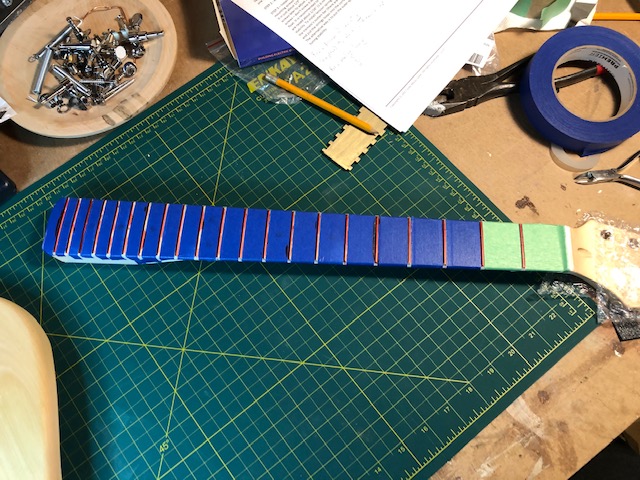
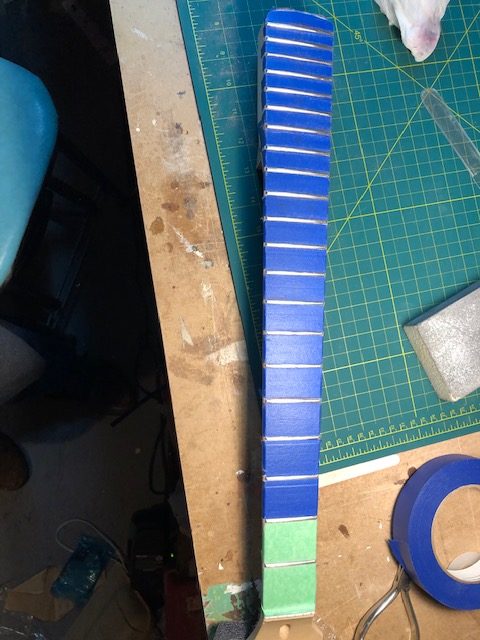
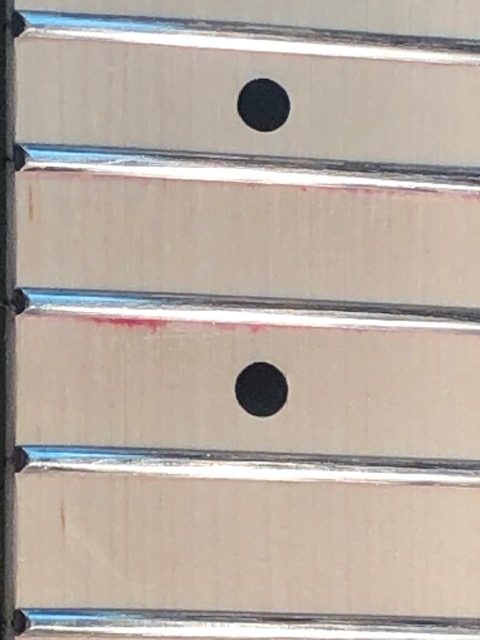
Now onto the fret leveling. First things first, need to tape the fret board so I don’t mess up and scratch it while leveling. I used a fret rocker to measure each block of 3 frets to see if any are high or low. If the frets are not level, there could be some fret buzz while playing. At least that is what I am told. (BTW – I am throwing out buzz words as if I know what I am actually talking about). 3 of the frets were not level with the others. That means that I have to level them. Before taking a file to the frets (I don’t have any fancy luthier tools that would make this job easier) I took a red sharpie and marked all of the frets. Now when I file them, the red sharpie is removed and I know where I still need to file. The filing went very well, I got all of the sharpie marks off of the frets. The secret was to go slow and careful. I think that I now have the frets level.

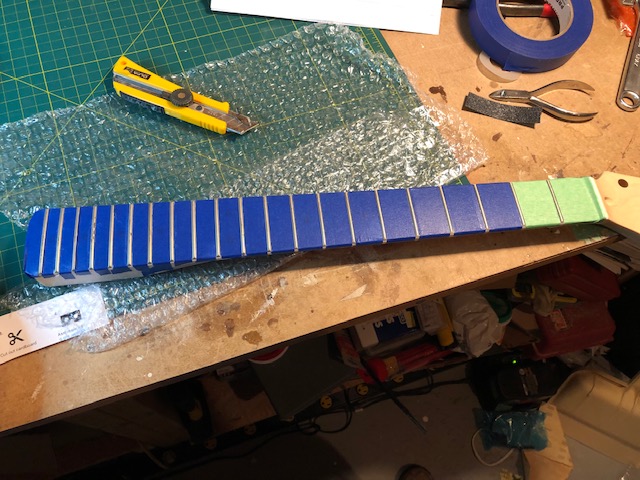
Beveling the frets. Now that the frets are level, time to make sure there are no sharp edges on the frets. As I am very luthier tool lacking, rather than a diamond file or specialized tool, I took a fingernail emery board and removed any sharp edges and beveled the frets. This means I made them round again. Then I polished the frets with some silver cleaner which is all I had available at the time. Now they look marvelous. Nice and shiny.

Sacrifice to the Guitar Gods. After I taped up the fret board and put the red sharpie on the frets, I went back to You Tube and the web to make sure I was doing everything correctly. Unfortunately, I found a sight that said “If you have a maple fret board, DO NOT mark the frets with a sharpie, as it may bleed through the masking tape and stain the maple”. Man, I wish I had found this site about 20 minutes earlier. If nothing else, I would have used a different colour. As you will see in the pics, there was some bleed through. I will now officially change my story. In order to appease the Guitar Gods, I had to make a blood sacrifice and the red marks are what I could not get clean.
Building a Guitar – Day 1

Well, since deciding to purchase a guitar kit to build my first electric guitar, I have watched several series of You Tube videos of building guitars, I finally settled on a couple of guys who build guitars for a living. I will follow Brad Angove as he has a series to build a guitar from a kit from Solo Guitars which is where I got mine.

One of the things I did first was order some tools from Amazon. I looked at the cost and settled on a specific fret tool mainly because of the price only to find out when it arrived, it was cheap for a reason, not the right size and has a slight bend in it. Lesson learned, you get what you pay for.

I have decided that I will paint the guitar with Black Pearl paint and go with a clear coat at the end to make it really shine. Hopefully, I will be able to achieve the same finish or better than the finish on this test piece. And for those of you with a keen eye, there are some scratches on the wood. They are there on purpose to show me how obivous it will be if I don’t prepare the wood properly.

Well, the guitar arrived. I opened the box and looked inside and every thing is there to complete the guitar. Most of the components are probably the cheapest of the cheap, but my plan is to build it as is for now, and then replace everything with quality parts as part of my training to become a luthier.

The task right now looks daunting and there is a lot of work that has to take place. What have I gotten myself into? All I did the first day was clean up my workbench so I have somewhere clean to work and unbox the guitar. Oh yeah, and opened the box as you will see in the pictures. Now I to get to work and do some assembly. Stay tuned for Day 2.

Becoming a Luthier

Hi there. I has been quite a while since I have updated the site. I am still working with wood (or at least trying to) but have not done anything that I consider worthy of exposing to the world. I still have lots of projects in the works, but nothing finished to my satisfaction yet.

So, I recently started taking guitar lessons again after nearly 40 years after my last guitar lesson as a teenager, just for something to do. Almost immediately I thought, since I now have a passion for learning guitar, why not combine it with my passion for woodworking and build an electric guitar, with the ultimate end goal of maybe having a new revenue stream when I retire. I did what everyone does when they want to learn a new skill, I went to You Tube and started watching videos of building guitars. Then what really caught my eye was the possibility of using a CNC router to create the guitar bodies and necks, and then paint (or other finish) them and assemble all of the parts and voila, I am in business. Any excuse to justify buying a CNC router. I started by searching for a video on drawing a guitar in Fusion 360 (CAD/CAM software) and realized that I understand the basic concepts of what the person was describing as he drew his guitar, but not nearly enough to really know what he was talking about in any detail. So….. time to start with the basics.

Become a Luthier. For those who don’t know what that is (I had to look it up too) ” A Luthier builds and repairs stringed instruments that have a neck and a soundbox”. In my case, it will be limited to guitars for the time being. Despite there being thousands of videos on You Tube on building a guitar, they are usually done by someone who is very experienced in building guitars and they fly past all of the little details you need when you are staring out. Not a great way of leaning from scratch. As a result, I did what everyone does when You Tube is no longer an option, I went to Amazon and bought a book on building guitars. As there are not thousands of books out there, it was easy to narrow it down to a few and I picked one to start with. Building Electric Guitars by Martin Koch. I have read most of the book (still a few chapers to go) and now realize that this is going to be way harder than You Tube will have you believe.

The only real way to understand the concepts is to build a guitar following along with the process described in the book. However, there are still a lot of unknowns that will only come with time and experience. Instead of building everything from scratch, following the advice of many people including my guitar teacher, I purchased a kit guitar that has everything needed to create my own guitar. More on this in the next blog post.

I know that by watching a hundred videos and reading one book will not make me a luthier, but it is a start. In fact, by starting with the guitar kit, I will learn if this is something that I want to pursue or if it is just another notch on the experience belt. If I like building guitars, I will take a course put on by a master luthier in Chelsea, QC, ( yeah, close by) to build an acoustic guitar from scratch which will be a really good first step in a very long journey. I will keep you posted.

Merry Christmas to all WoodWorkers

Hi everyone. And by everyone, I mean one. (follower that is). Just a quick note to say Merry Christmas to all. And to all, happy woodworking.

My garage shop is too cold at the moment to do any work and the busyness (is that a word?) of the season has curtailed my adventure in woodworking. I hope to get back at it with an update on my shop vac enclosure and other fine works early in the new year. However, I may have to learn how to work with thick gloves on to combat the cold.

See you all next year.

Chris